

Introduction
This blog focuses on where ancestors and their descendants lived over time. The current genealogical software I use is Family Historian. For each life event, including births, marriages, and deaths, we record a location. Other events, like baptisms, burials, and censuses, are also recorded with a location. A feature lets users see all locations on a map, using their associated GPS coordinates. This is rather cool as you can isolate a family member and show their locations over a period of time.
For this blog, I thought I would show on a map of the UK and the world the locations during various points in time. It starts with the furthest I have gone through each line. It covers a period of nearly 350 years.
1680 to 1699
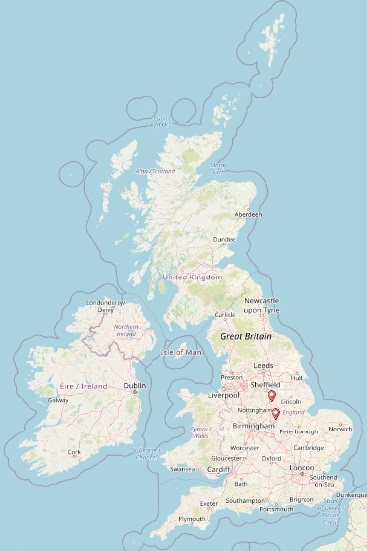
The earliest date recorded so far is around 1680. It is for my 7th great grandparents John Clark and Catherine Bilby, from Sutton-in-Ashfield, Nottinghamshire on my paternal line. Charles II was sitting on the throne of England.
A 1690s record shows Thomas Oswin and Mary Church from Sileby, Leicestershire. They are also from my paternal line. William of Orange and Queen Mary II were now on the throne. I haven’t got that far on my maternal line yet. See the map of the two locations.
1700 to 1749
By this time, 1702 throne had passed to Mary II’s sister Anne, who was the last of the Stuarts. In 1707, Scotland joined England and Wales to form Great Britain with the result of the Acts of Union. 1714 throne switched to the start of the Hanover dynasty – George I, followed by George II.
The next map shows more family members traced back. I can trace my ancestry back to my 5-times great-grandparents on both sides. Now, only parish records for baptisms, marriages, and burials are available. Many have transcribed these records. Websites like Ancestry, FindMyPast, and MyHeritage offer them online, but they require payment. Otherwise, most are available at various county and national archives.
- Midlands for paternal line –
- Nottinghamshire (Sutton-in-Ashfield, Mansfield) for the Challoner, Clark, Rhodes and Hill lines
- Derbyshire (Heanor, Ticknall) for the Blount line and a different Hill line
- Leicestershire (Sileby, Appleby Magna and Desford) for the Oswin, Godfrey and Billings lines
- Scotland for my maternal line
- Contin in Ross and Cromarty for the Cameron line
- Prestonkirk, East Lothian for the Dunbar line
- North Aberdeenshire for the Ritchie line

1750 to 1799
During this time, the Hanoverians, led by George III, remained in power. America gained independence, and France experienced its revolution. Meanwhile, Great Britain experienced the Industrial Revolution drawing people from rural areas to cities for work.
The 1841 census simplified my research by revealing birth years and potential ancestor locations. I still relied on parish records for information about ancestors and siblings.
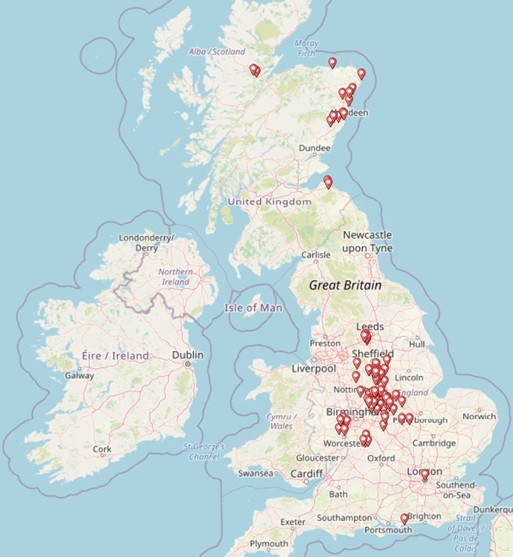
My paternal line is still showing up in the Midlands. The surnames – Challoner, Blount, Rhodes appeared in Sutton in Ashfield. Oswin line remain in Sileby. Billings in Desford. I have found several 4-times great-grandparents: Wilton, Richards, Bird, Lakin, Bakewell, Bishop from the North West Leicestershire area. Their towns included Coleorton, Worthington, Lount, Breedon on the hill and Thringstone. Godfrey line is also still in Appleby Magna. The surnames Rushton and Peace from the borders of Leicestershire and Derbyshire. They are from Chilcote, Norton Juxta and Church Gresley. Most of these ancestors worked as agricultural labourers or frame work knitters.
The maternal line was starting to appear more in Scotland. My 4-times great-grandparent surnames are: Imlay, Ritchie, Mutch, Rennie, Cameron, Mackie, Smith, Hadden, Moir and MacDonald. All are from Aberdeenshire, Kincardineshire and Contin, Ross and Cromarty.
Another maternal line of surnames was Silk and Brown from Kidderminster, Worcestershire. Flockton, Yorkshire (near Leeds) was the location of the surnames Lister, Mountain and Kaye. These places were carpet weaving businesses, particularly related to the Industrial Revolution.
1800 to 1829
At the start, the Napoleonic Wars (1803-1815) involved Great Britain, and George IV ruled during the Regency period (1811 to 1820) before being crowned in 1820.
Parish records were a key source then. People born during this period likely appeared in the 1841 census and had death records from 1837. This made research easier. Also, trade and local directories, like Kelly’s and Pigot’s, aided research.
Most of my 3-times great-grandparents would be born in this period. The Silk family stayed in Kidderminster. Kaye and Mountain in the Flockton, Yorkshire. The Warwick and Bigley families emerged in Leicester.
The Scottish family were stable. The Cameron’s remained in Ross and Cromarty. The Mutch, Dunbar, Hadden, Harvey, Mackie, Ritchie and Imlay families stayed in Aberdeenshire or Kincardineshire for the most part.
On my father’s side, many stayed in Sutton in Ashfield, Nottinghamshire but also moved across to North West Leicestershire and Derbyshire. The Industrial Revolution created a high demand for fuel, first from wood, then coal. This need sparked many jobs, drawing people from the countryside to towns. Nottinghamshire, Derbyshire and North West Leicestershire were rich in coal. Hence, many of my paternal ancestors became coal miners. The map shows a growing area of ancestors moving into Staffordshire, Warwickshire and parts of Yorkshire. Some came from other areas, drawn by coal mining jobs and family ties.

1830 to 1859
George IV brother William IV became the next king during the period from 1830 until 1837. Then the Victorian period started when his niece Victoria became Queen in 1837 at the age of 18. Great Britain was in a period of transition, with the industrial revolution in full swing. This enabled the growth of railways making it easy to travel and transport goods.
The British Army was busy fighting during the Crimean War (1853 – 1856). So, I have discovered a couple of cousins involved using military records. There were a lot of social reforms with increased literacy and childhood education.
From a records point of view, the censuses of 1841 and 1851 records were a good source. 1841 indicated names of people, rough age and whether they had been born within the county. 1851 census provides better data, like age, birth places and family relationships.
The Births and Deaths Registration Act of 1836 founded the General Register Office. So, civil registration of Births, Marriages and Deaths began in late 1837. This source of information is invaluable for every genealogist along with parish records. But it wasn’t until 1875 that it became compulsory to register these events. Some ancestors can slip through the net. But, census records, trade lists and newspapers have helped fill the gaps.
In Scotland, the parish records remained the same until 1856. Then, their records became a better source. Parents recorded when and where their children were born and when they got married. Marriages recorded both sets of parents and their wedding dates. Deaths recorded spouse and marriage details as well. This made research of Scottish members incredibly easy. Most of these records is searchable on the Scotland’s People website.
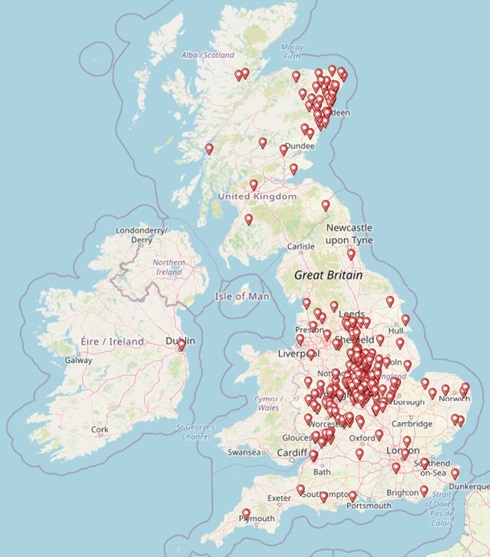
The next map shows family spread, likely due to railways and new opportunities. Some members born in Ireland moved over to marry into families in Leicestershire and Worcestershire. Scottish ancestors still seem to be mainly in Aberdeenshire and Kincardineshire. The Cameron’s had moved over there from Ross and Cromarty. Various members married into the Cameron’s and Ritchie’s from Banffshire, Perthshire, Lanarkshire and the Borders.
There is still a big mass contingent of family members in the Midlands. The Challoner’s from Sutton in Ashfield had started to move to places like Alfreton, Derbyshire and Oadby, Leicestershire. My 2-times great-grandfather Thomas Challoner was born in 1833. For further information on Thomas check out Victorian Police Constable Thomas Challoner. Leicester city still location of the Warwick’s and Bigley’s.
North West Leicestershire heavily feature for the surnames of Godfrey, Bishop, Rushton, Peace, Richards. Billings started to move from Desford to Coleorton area. Coal being product of the industrial revolution meant certain areas grew. Between the area of Swannington and Whitwick not far from Coleorton and Worthington grew a new area called Coalville from around 1833. This area became a very popular area for my ancestors who started to work the coalmines. Several ancestors served beer and other alcoholic beverages to the locals in this area too, particularly the Richards and Billings family.
Oswin’s still in Sileby. Town of Ashby de la Zouch started to feature for the paternal line of the Broadhurst and Withnall. Carpet Weaving Silk members remain in Kidderminster and the Kaye / Mountain family in Flockton area of Yorkshire. Other locations are members who have married into the various lines, which means they are coming from further afield.
1860 to 1889
Great Britain thrived and became dominate worldwide, trading with India and China. British Army supported the East India Company adding military strength. Diplomats also joined colonisation. This also led to new opportunities and travel. The Suez Canal in Egypt built between 1859 and 1869 made travel to the East easier. Meanwhile London opened its first underground railway in 1863.
After the American Civil War (1861 to 1865) the Americans began rebuilding. This led to an economic boom and sparked second industrial revolution, following Britain’s earlier one. Electricity became common, with first electric light introduced in 1878. Edison then invented the light bulb and in 1885, Karl Benz created the first automobile. These advances opened new opportunities. Thus, before the 1890s European immigration to the United States began.
During this period, the family began moving abroad for work and new lives. British Army was active overseas. The Crimea war had ended, but many postings remained, including Gibraltar for one ancestor. Elizabeth Challoner and Charles Rhodes Bowmar were the first to settle abroad. They moved to New Zealand’s South Island in 1860s. Check out blog about Elizabeth and Charles – Elizabeth Challoner (1840-1817) and Charles Rhodes Bowmar (1838-1816). With the promise of work in North America, several family members emigrated to the Sharpsville, Pennsylvania and Bridport, Connecticut in the United States. Others went to Toronto, Ontario and Cumberland, Nova Scotia in Canada. Some from the Dunbar line even moved to Queensland, Australia.
The next map of UK highlights the Midlands known for coal mining, hosiery business, shoe factories, carpet weaving and breweries. Families moved from Nottinghamshire, Derbyshire, Leicestershire to Yorkshire and into London. The second map shows the migration extent and birthplaces of diplomat’s families. They came from Germany, Pakistan, India and Malaysia later marrying into the Ritchie line.
This time marks the birth of all of my great grandparents. Paternal ones: Francis Thomas Challoner in Narborough, Leicestershire and Sarah Billings in Thringstone, Leicestershire. Then, Charles Godfrey in Appleby Magna, Leicestershire and Susannah Broadhurst in Stapenhill, Burton upon Trent, Staffordshire. On the maternal side: James Reidford Ritchie and Elsie Harvey Dunbar in Aberdeenshire. Plus, John Henry William Warwick in Burton upon Trent, Staffordshire and Mary Louisa Silk in Liversedge, Yorkshire.


1890 to 1919
This time was close to the end of the Victorian era and the start of the Edwardian era. It began with Edward VII reign in 1901 followed by George V in 1910. The period ended after World War I. It was a not a tough period for Great Britain, marked by war and mass immigration to North America.
The main data sources for research for this period were the GRO registration, parish records, military records, electoral rolls, newspapers and census records. Notably, the 1911 census was particularly useful. It included columns for years of marriage along with number of children born and passed away. All of my grandparents were born in this period in Leicestershire, Staffordshire and Shropshire.
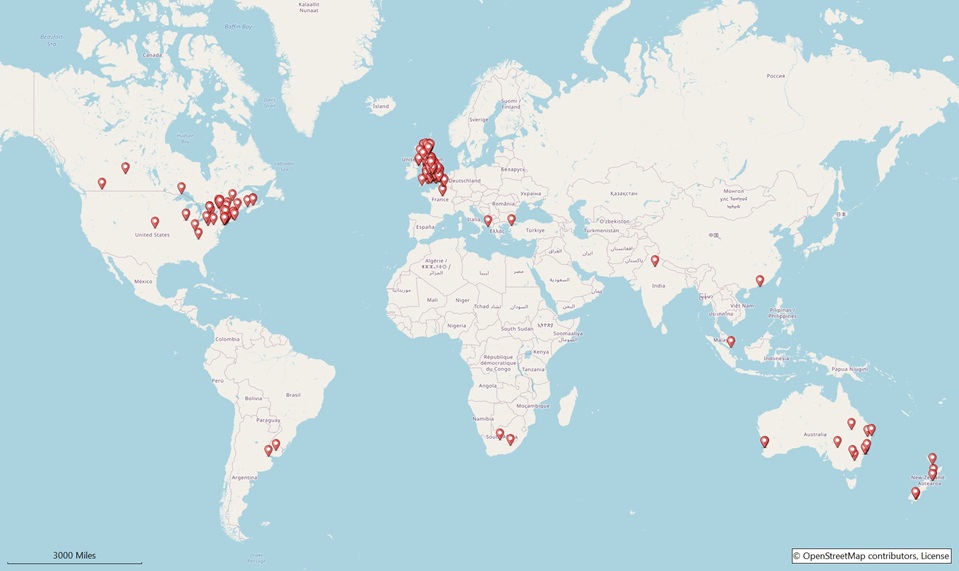
The world map below shows some ancestors’ migration to North America and travel around the world. The Ritchie family from Aberdeenshire were granite quarry men. They travelled the world to help build roads and harbours in places like Hong Kong between 1901 and 1909. One even moved his family down to Uruguay for a bit. Some of the Ritchie family moved to Canada, reaching as far as Nelson, British Columbia. I have yet to blog about them.
America continued to expand and encourage immigration. The Silk family from Kidderminster moved to Amsterdam, New York drawn by its thriving carpet weaving industry. For more, check out Silk blog – Carpet Weaver James Silk. Some Warwick’s also made the move as noted in the blog for Brewery Cooper John Warwick. Meanwhile, several descendants of Elizabeth Challoner, who had emigrated to New Zealand moved Canada and America. For details, see the following blogs – Gershon Bowmar (1866-1937) and Stanley Bowmar (1881-1965). The immigration records and the federal census for both America and Canada were a good data source.
In the UK, coal miner ancestors stayed in the Nottinghamshire, Derbyshire, Yorkshire and Leicestershire as long as there was work. Mining was a tough and dangerous causing many family deaths. Gradually the family spread across England and Wales taking on various jobs. These included teaching, domestic work, gardening, painting, printing and policing. The Godfrey family expanded from Appleby Magna to Ashby de la Zouch, Rearsby, Ravenstone in Leicestershire. Some also moved to Kettering in Northamptonshire.
Research revealed that some family members died in France during World War I. For instance, Thomas Jarvis Horne married Edith Challoner in 1909 moved to the United States in 1910. The Americans didn’t join the war until 1917. So, he enlisted in the Canadian Army. Sadly, he died in 1918.
The UK map shows some Scottish ancestors moved to England. My great grandparents James Reidford Ritchie and Elsie Dunbar settled in Aston Botterrell, Shropshire between Ludlow and Bridgnorth. The rest of the Scottish rellies stayed in Aberdeenshire.
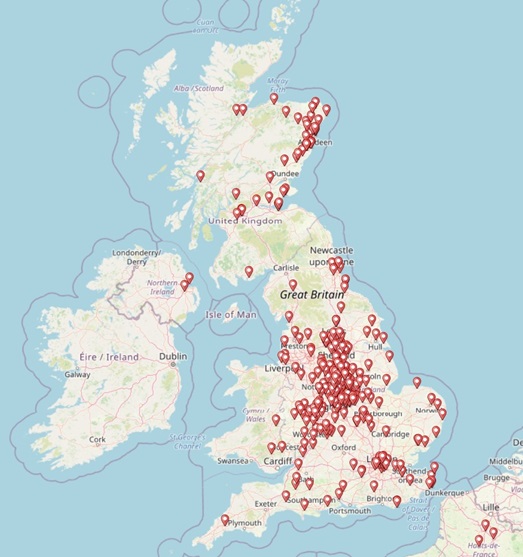
1890 and 1919 showing several ancestors having moved from Scotland into England. Ancestors having to move for work
1920 to 1949
The interwar period (1918-1939) followed World War I and the Spanish flu pandemic. Both events caused significant loss of life. Economically, it was a challenge for both the US and UK. US faced a major downturn during the 1929 Wall Street crash, leading to the Great Depression. Meanwhile, the UK dealt with high long-term unemployment hardship. Yet, the UK outperformed the US building homes. UK quickly expanded the home building especially in suburbs, while US house construction stalled. Then World War II (1939-1945) struck. British monarchy also changed. George V was succeeded by Edward VIII followed by George VI.
Researching this period was somewhat easy. Particularly when 1921 census became available, along with electoral rolls, newspapers and GRO registrations. The 1931 census was conducted, but its records were destroyed in the World War II blitz. However, the 1931 census records survived because they were stored there. On the eve of World War II in the UK the 1939 register was created listing names, birthdates and occupations. This register became available to be transcribed and searchable a few years ago in England and Wales. However, the Scottish ones won’t be available for a while yet.
North American family research relatively straightforward with the use of federal census, newspapers and immigration records. Australian and New Zealand research is harder. The census records were not kept for future reference, so only birth, marriage, death registration and newspapers were of use.
The next UK map is similar to the previous period. However, there was movement between towns and counties. Challoner, Billings, Richards, Godfrey, Broadhurst all remain in the North West Leicestershire area. Warwick in Leicester or Birmingham. Ritchie and Silk in the Worcestershire/Shropshire area. Meanwhile, Dunbar, Ritchie, Cameron, Hadden would remain in Aberdeenshire if they hadn’t moved into England or immigrated.
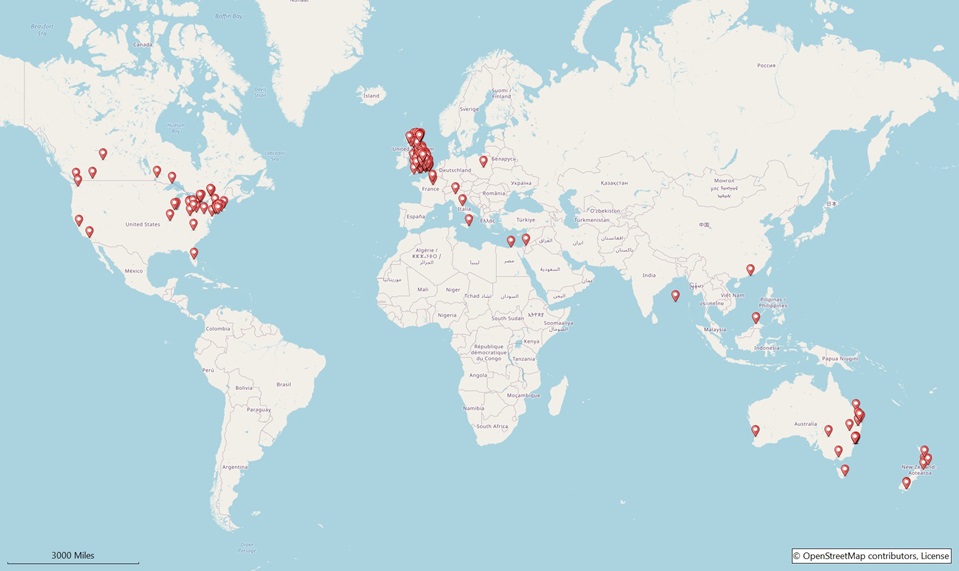
The world map now includes more locations in Australia, New Zealand, United States and Canada. It also highlights France, Egypt and Malaysia marking the homes of some war casualties. My research uncovered a few Challoner members involved in the war, particularly over in Malaysia and Thailand during Japan’s invasion of Asia. Some died, while others became prisoners of war. I haven’t delved much into military records, but I am sure there are more members to find.

1950 to now
Now coming into modern times, Britain and the rest of the world had to rebuild post-war. Elizabeth II ascended to the throne in 1952 until she passed in 2022. The throne has passed onto Charles III.
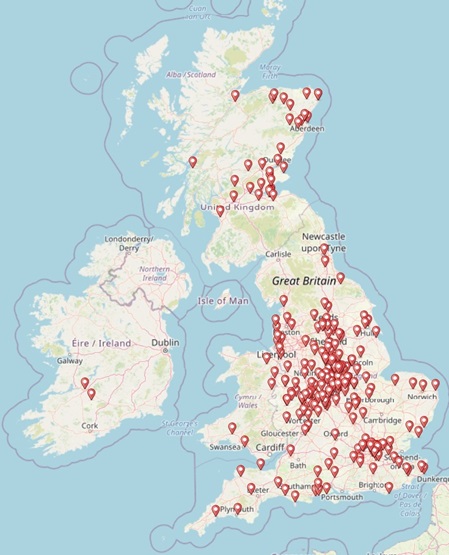
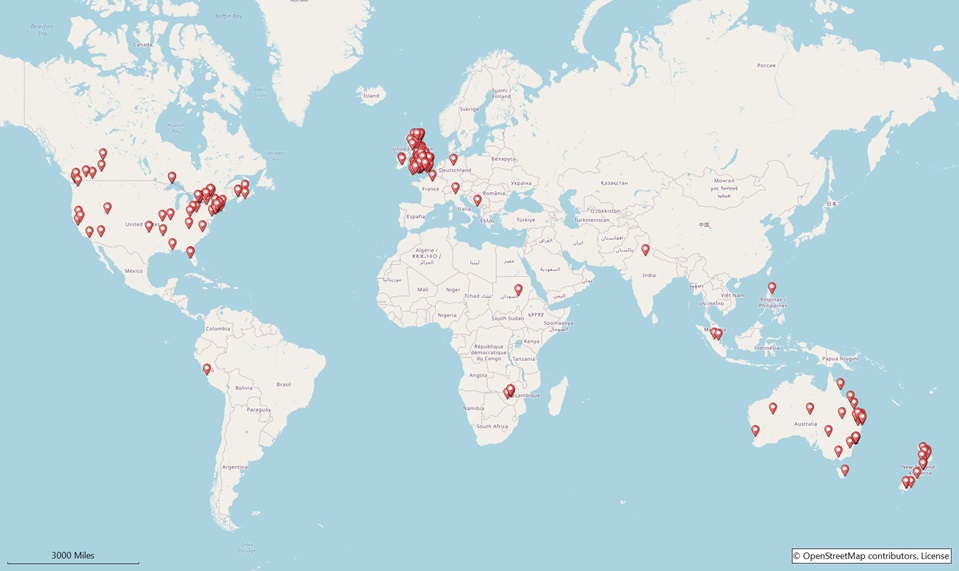
The maps still show changes for both the world and UK. More cousins in Australia, United States and Canada. The UK still shows a very popular Midlands. But members starting to spread out to Cornwall, Devon, East Anglia and the South Coast. This is due to more members going to university in different areas or moving away due to jobs. Travel by car has made commuting to jobs easier. Air travel also has made immigration to places easier.
Conclusion
Tracing my ancestors has very been fascinating. I’ve seen how world events affect my family. It has also matched with my DNA matches (check out the DNA blog – Discoveries using DNA Ethnicity). Clearly, I need to research more, especially beyond 1680s.
The genealogical software shows how often each location is mentioned, such as for birth, marriage, death, burial, baptism and census info. I conclude this blog with the top twenty most mentioned locations. Number 1 being the most mentions of over 2000 record links. Number 20 being well over 100.
- Leicester, Leicestershire
- Coalville, Leicestershire
- Sutton-in-Ashfield, Nottinghamshire
- Ashby-de-la-Zouch, Leicestershire
- Sileby, Leicestershire
- Swannington, Leicestershire
- Coleorton, Leicestershire
- Kidderminster, Worcestershire
- Nottingham, Nottinghamshire
- Whitwick, Leicestershire
- Aberdeen, Aberdeenshire
- Appleby Magna, Leicestershire
- Burton upon Trent, Staffordshire
- Alfreton, Derbyshire
- Worthington, Leicestershire
- Rothley, Leicestershire
- Staunton Harold, Leicestershire
- Skegby, Nottinghamshire
- Hugglescote, Leicestershire
- Basford, Nottinghamshire
 Debbie's Discoveries blog
Wow. What a great way to chart the history of your family. It’s incredible you’ve managed to go back so far. Love that you’ve mapped your family not just onto geographical locations but also historical eras and events.
An amazing piece of work Debs. Very well done.
LikeLike